Posts

Something About Size

Image
Something about size. If you use a microscope, telescope, or even climb to the top of a building, you’ll feel like you’re seeing more in some ways. But actually that’s not true, you’re definitely seeing things you couldn’t see without doing those things, but notice how what you gain in one dimension you lose in another. Looking from the top of a building let’s you see a wider extent of the city, but what you gain in width you lose in detail. Ditto for a microscope or telescop e, what you gain in magnification you lose in width, dramatically.  The point being, every point of view sees roughly the same amount of stuff. There isn’t a better one that lets you see more than another, it’s always a trade off between detail and width. And I think that’s also true for any part of life where we use ‘point of view’. A CEO looking at graphs about their company is not seeing more about the company than the employees, they’re just swapping detail for width. A government d...

Occultism

Have lived this firsthand. Steiner was an occultist, and occultism was very big in the 19th and earlier 20th century. The term occult and 'cult' are related - occult thinking tends to produce cults, a word that has significant negative connotations in our era, because of what some cults have done, but the occult can be discussed separately to that as well. The specific meaning of occult is 'knowledge of the hidden', of saying there is a deeper spiritual knowledge going beyo nd the physical sciences and pure reason. Steiner's Theosophy was just one of several occult movements that emerged in the 19th century. They're all marked by claims to access deep, esoteric truths that are separate to common knowledge - that's what occult actually means, as a word. It's why occult thinking produces cults, groups of people unified by their 'special' knowledge. All occultists have some common characteristics, including belief in ancient knowle...

Is LGTBTQI a 'community’?

Image
More we. Often LGBTQI people are said to be a ‘community’. Think I’ve asked here before - are they really a community? Does sexuality define a community? Or is this just another way to marginalise people who are a bit different, by saying they’re ‘all the same’? Patrick White first made me wonder about this, when he criticised the Mardi Gras as not representative of him, as a gay person. Hanna Gad sby makes the same point ironically, calling the LGBTQI community ‘her people’. There are however groups of people in all walks of life with overlapping desires and interests. That’s something a bit different I think. Similarly as a straight white male, I think it’s important to understand the ways in which that category is real, without necessarily believing that it's a community too. That’s what I suspect irks people most, to be linked to categories or communities to which they don’t feel they belong. But at the same time we need to understand in what ways categories l...

Holes

Is a hole a thing? It’s nothing, an empty space, but then why give it a name? A hole in a bucket or donut or sock or road - part of the bucket/donut/sock/road, or its own thing? Is the inside edge of a donut part of the donut, or the hole? This stuff actually has serious implications. Another example would be ‘personal space’, it’s just empty space, but it’s ‘personal’?

Jealousy, not something to cure

Image
You can find a lot of advice about jealousy along these lines. Nearly all of it is like advice on how to look after your car. Jealousy may in fact be the essence of all love, and the fact we try to ‘cure’ it suggests again that we don’t really understand love. The essence of love because jealousy recognises that your partner is fundamentally unknowable to you, and even when they love you, they do so for their own reasons, not yours. Ironically, every tiny thing we introduce into a relationship to make it more special for us will make a jealous person suffer even more, because those special things will be things they can also imagine being offered to somebody else.  I don’t think the answer is to try to regulate jealousy, as in these sorts of articles. I think it’s to embrace it, reframe it, recognise that those feelings are pointing to why you loved this person in the first place, because they weren’t you and something about that difference attracted you. You won’t take the...

The fantasy of falsification

This was always a fantasy. I’m yet to meet a person who actively tries to prove themselves wrong. https://aeon.co/videos/falsification-ruled-20th-century-science-does-it-need-revision-in-the-21st

Binaries and absolutes.

Love Aeon. This topic is one I cycle back to regularly - binary, absolutist thinking. Often linked with high stress, anxiety and depression (which it tends to cause, rather than be caused by it). Splitting things into this or that, no mixtures. In emotions too, sentimentality, everything being either the most amazing thing ever, or a catastrophe. A standing ovation or demanding your money back. Subjects or objects. Body or mind. Nature or nurture. Spirit or matter. Religion or science. Left or Right. It’s the age we live in. Aeon and binaries.

Agency

Image
For a long time, the world was divided up into those things with consciousness, and those things without. The first list was very small, the second list huge. A lot of fields are shifting how they think about this now though. I think a much better concept to understand all of this is the notion of agency, which has become a hot topic of research. It doesn’t carry the same human baggage as consciousness. Everything has agency in some way - the capacity to act, to force other things to react in some way. Take this sign as an example. Who is the sign talking to, and who is talking, in the sign? I’ve always thought a workplace with a lot of signs like this is probably a dysfunctional place, because nobody is quite sure how to solve a problem, so they delegate it to a sign. The sign has agency. It may or may not actually work, so its agency may be limited.  

Patterns. Christopher Alexander.

Image
Christopher Alexander, the architect, was one of the first to put me onto patterns as a topic. Alexander noticed that beautiful buildings in history shared some common patterns, basic things like ‘light from two or more sides of the room’, that could be translated from one building to the next without determining the full design. He designed a full ‘pattern language’ that even people with no experience in architecture can use to design beautiful buildings, realising that these patterns aren’t so much geometrical as like a path in a landscape - patterns of activity and life. Most modern buildings come from blueprints, drawn as shown. They don’t allow the design to evolve much during building, it’s a two-dimensional pattern pre-determined on the draughtperson’s table. So the buildings don’t really live. A building is not an object, it’s an interactive, ongoing creation. Patterns of movement and activity and materials determine how a building is built and how it gets shaped over ti...

Transcendence and Immanence

The opposition between what’s beyond us in some way - transcendent - and what is inherent to us - immanent, is one of the big tensions in history. But I think all opposites are fake. Take a company as an example, is it transcendent or immanent? We often talk about corporations as if they’re transcendent things, actual Beings that rule over us. But if you’ve worked in a corporation you know it’s not simple, people like you and me work in corporations, so they’re us in some way. They’re immanent. But they also go beyond us in some ways, nobody within an organisation actually controls it. There’s transcendence there. Language is the same. I’m using these words, but I didn’t invent them, they’re transcendent to me in some way. But I can also shape them myself, have some choice how to use them; they’re also immanent. All things are both transcendent and immanent, at the same time. We often miss that I think, looking for transcendences like ‘God’ or ‘the government’ or ‘capi...

Our Peaceful TImes

Data and visuals suggesting strongly that today is easily the most peaceful time in human history. Also shows that States or governments - the things many have a passion for destroying today in their hatred of government and politicans - have always historically been associated with massive reductions in violence. Finally the slides ponder why we've become more peaceful over time, and assumes this must be because of something people are doing differently. I don't think it's that, it's because we've built things called 'technologies', that are actually social webs of people. People alone will generally fight to the last person standing, you need objects to bring peace. https://ourworldindata.org/slides/war-and-violence/#/end-slide

Machines are us.

Image
Our politics looks like society is at war, but actually we live in some of the most peaceful times in human history. It’s impossible to understand that paradox I think if you only look at humans. An example - trains. When trains first came to towns, they didn’t just bring transport and freight. The train linked the people in the town directly to people everywhere else. Goods brought into and taken out of town set up relationships between the people in the town and the produce rs of the goods. Suddenly a fisherman on the coast had a customer in the bush, and the two now had an ongoing tie between them. Etc.  I think this is how society is actually held together. Technology isn’t a tool, it’s a complex web of social ties. Here is also the world’s first org chart, which a railway also produced. You can see directly on the chart how those social ties were beginning to be created. All of those people were now connected in an ongoing way, their lives and work were relian...

Posture. The Great Big Rump.

Image
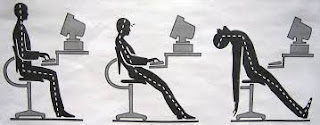
Many of us work in offices, where a large part of every day involves sitting at a desk. Something we practiced for years at school as well. Musculoskeletal disorders have emerged to reflect this, with a proliferation of different forms of strain and injury caused (apparently) by all of this desk work.  And in recent years there has been even more alarming news for desk workers, with claims that too much sitting can even be lethal, this sort of thing: https://www.washingtonpost.com/apps/g/page/national/the-health-hazards-of-sitting/750/ Is sitting really so terrible? It seems the most innocuous and gentle of human activities. Arguments will be made that it's the amount  of sitting that we now do which is the problem, that we're more sedentary than our ancestors. That sedentary idea is important here, much of the danger of sitting relates to it (again, apparently) being a static, unmoving thing, unlike walking or running for example. That's a framework which needs a...

Two ways to approach presence. One hopefully much easier than the other.

Image
Presence traditions, particularly mindfulness, are popular and making inroads into both personal and professional life, including into medicine.  The basic approach is as simple a thing as you could imagine. Just let go, let things be as they are, discover the power of letting yourself automatically respond to things rather than always reacting to them. To not try to make things right or any particular way, but to let them them just be as they actually are. Whether that be in your body, in your activities, or whatever.  Common training in achieving this sort of presence includes people being encouraged to learn again how to pay attention to things, to focus on their senses; on what they see, hear, smell, touch, and so on. It's this attentional workout that can lead people astray, however, or at least get them stuck in years of repetitive, fairly meaningless sensing. A sort of trap, where people continue to be as reactive as they always were, while simply chang...

OMG. God stuff.

Image
Look down after rain and you'll often see this, leaves and other plant material arranged neatly into long arcs, with silt banked up on the concave side. Sometimes there are many rows of these arcs. This is the way that bare ground is often re-vegetated, the wall of plant debris traps silt, which builds up new soil behind the wall. Grass and other plants then grow in this soil, and what was previously bare ground is now covered. What's wonderful about this is that it happens all by itself. Looking down at these soil traps, in their regular rows, it would be tempting to assume somebody had organised the whole thing. But the water and plant material and soil do all of this by themselves.  In the debates between atheists and those in traditional religions, there is a lot these little walls of leaves have to teach people. Most of these debates revolve around the nature of design and purpose in the world, about whether somebody or something (God) is behind the scenes pul...

Why organisational culture, values and leadership might be things to leave alone

Image
(No it isn't.) Anybody who works in an organisation, particularly a large organisation, will have noticed in recent years much talk about 3 things: 1) organisational culture 2) organisational values (and mission), and 3) leadership. I'm going to suggest that if you're focused on these things, you may be barking up the wrong tree. And it's a long story as to why this might be. To cut the long story short, for hundreds of years if not longer, much of the West has used a distinction it calls the "fact-value distinction" (Hume for example codified this clearly). Or in other words, it's made a sharp split between what "is", and what "ought to be", claiming that you can't argue what ought to be simply from what is. This extends into values more generally. So it's one thing (apparently) to have some sort of facts about the world - how the world is - but another to overlay these with how you value these facts. For exampl...

Stere-oopsis (Part 1)

Not a typo. Stereopsis is the technical term for the perception of depth using binocular disparity, or in other words by each eye (apparently) seeing a slightly different version of the same scene - because each eye has a different 'line of sight', parallax occurs between images seen from those separate lens of sight. Which again just means the two images are different, which you can easily test by covering or closing one eye and then the other, alternately, and noticing how the scene in front of you changes slightly. I said not a typo because this theory is probably wrong. So more "oooops" than ops. But it's far and away the most common theory of how we see in depth, which I've talked about and questioned a few times, see here . (Note that links will show below this post, you'll have to scroll down.) There's no doubt you will see profound depth using stereopsis techniques, such as the ones most commonly used in 3D pictures and films. There's ...

3D Coming Soon

I've been working on a very different set of ideas around why 3D works for a few years. It's almost done at last. Here's a taster. Click anywhere to focus on any part of this image, or click and then move your mouse, to shift the image in any direction. Watch the 3D pop out at you (hopefully). From the new Lytro camera, empirical proof of the set of ideas.

Open is not the Opposite of Closed

Image
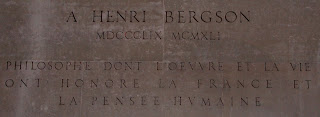
Open education. Open society in general. What does 'open' mean? In education, openness is currently a bit of a cause celebre. Rapid recent developments in 'online' education have led many to question whether standard institutions in education are under threat, to be replaced by a variety of new models of teaching and even research that take place online. Henri Bergson was a brilliant thinker on openness. And on many other things (his Matter and Memory must still rank as one of the most extraordinary books of the last 2000 years, his Nobel Prize surely had a lot to do with that book alone). What Bergson realised was that we make the mistake of trying to define open as the opposite of closed. Just as we tend to make all sorts of similar mistakes in opposing night and day, love and hate etc. To Bergson, defining openness by making it the opposite of closed is like calling somebody a boofhead, and when they object saying, "ok ok, you're a not-boofhead the...